


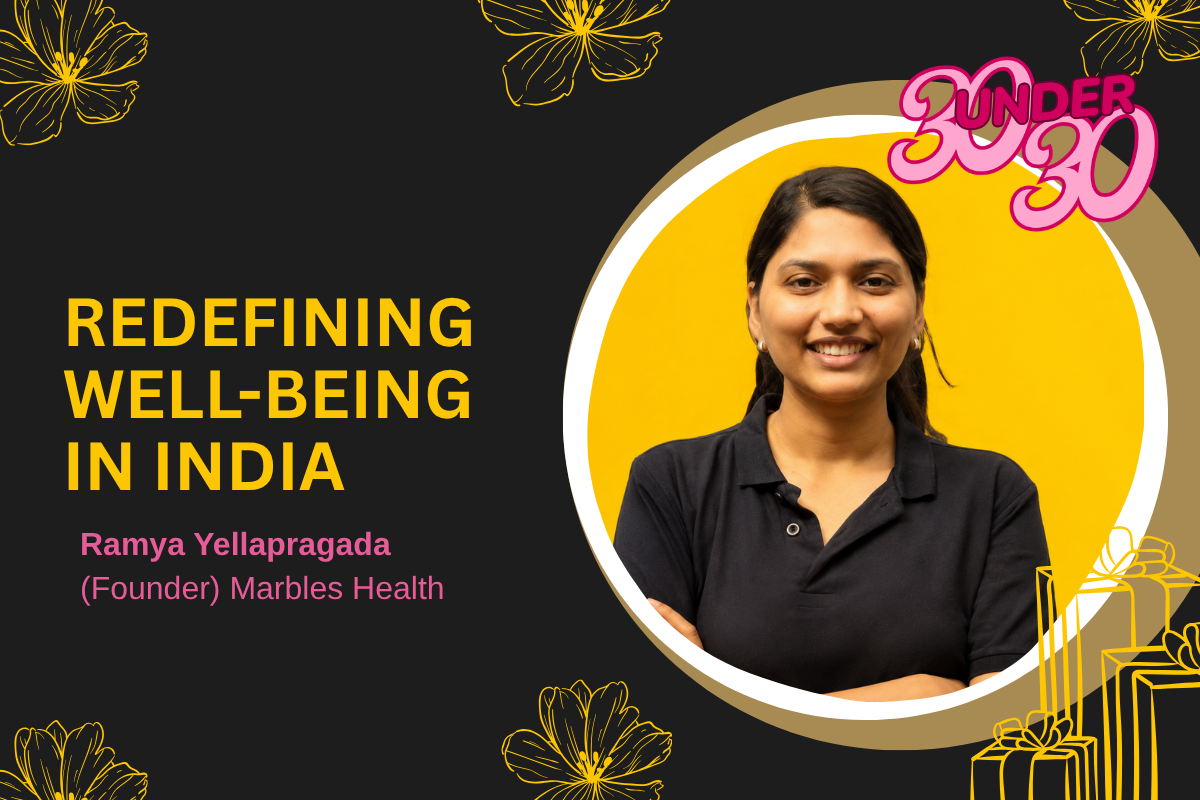
In India’s fast developing startup ecosystem, innovation is linked with technology, scalability and financial disruption. But some of the most significant technologies aren’t about changing industries—they’re about changing conversations. Ramya Yellapragada is one of the uncommon breed of entrepreneurs who are not just creating goods but transforming how society perceives itself. She is a co-founder of Marbles Health.
Her story isn’t just about starting a mental health firm. This is about shattering a deep cultural silence when emotional wellbeing has been disregarded, misunderstood or stigmatised for too long. In a country where people don’t talk about mental health, Ramya wanted to create a platform that makes such conversations apparent.
This is not a story of accomplishment; it is a story of developing consciousness, empathy and deliberate innovation.
Early Life: Witnessing the Unspoken Truth
Ramya Yellapragada’s early years were marked by intense observation. She had grown up in a culture that rewarded academic and career achievement, and she saw a division: external accomplishments were celebrated; interior battles were rarely mentioned.
Like many young Indians, Ramya has witnessed emotional challenges dismissed as seasonal or personal failings. Stress, anxiety and burnout were commonplace but never handled seriously or given structure and help.
These early discoveries did not lead to immediate action, but they planted a seed – a realization that mental health was not just an individual problem, but a systemic problem that affected millions.
This awareness over time became a deeper curiosity:
Second, a culture that strives to be outstanding ranks emotional well-being high. Why is that so?
Education and Exposure: Understanding the Magnitude of the Problem
Her time at Ramya as a student gave her the opportunity to view different perspectives from India and the world. That awakened her eyes to the difference in perception of mental health around the globe.
In more mature ecosystems mental health concerns were becoming mainstream — underpinned by established processes, professional networks and accessible platforms. In comparison, India still has major gaps in awareness, access and affordability.
The need wasn’t the issue, Ramya knew. It was the absence of infrastructure and openness. Millions needed help, but few had access to secure, reliable, stigma-free resources.
It was a shift in her thought process. She realized that mental health was a societal problem, not just a health problem, and that it required creative solutions.
From Awareness to Action
There’s that point in every entrepreneurial journey, that moment of transition from observation to action. But for Ramya, this moment came from a simple but great realization:
If people aren’t asking for help, maybe the system needs to go to where the people are.
This was a radical shift from the norm in mental health care where people had to go out and proactively get therapy, a step many are put off by because of stigma or not knowing how.
But Ramya saw a different model – one that would make mental health part of everyday life, accessible, relevant and not intimidating.
She didn’t want to wait for people to get over hurdles, she wanted to remove the hurdles.
Marbles Health: Putting you back in control
This concept gave rise to Marbles Health, a platform that simplifies mental health support and makes it more inclusive .
Marbles Health is different from traditional treatment in that it is built to provide a seamless bridge between the individual and professional care. It’s a platform that blends technology with human empathy and provides organized, yet flexible, help systems.
The plan is built on three basic principles:
Accessibility: Providing mental health treatments to more people regardless of where they live or what their background is
Affordability: Making help affordable for everyone, not just the fortunate few. Acceptability: Establishing an environment where it is common and not stigmatizing to ask for aid
Marbles Health is not just a service provider, it’s the fundamental challenges they fix that are actual change agents.
Challenges Along the Way: Navigating Sensitive Terrain
Starting a mental health firm in India is not without its challenges. Mental health is a distinct thing. It’s about the appropriate blend of technology, ethics and human sensitivity.
Social stigma was one of the biggest challenges Ramya had to face. It wasn’t only marketing that drove individuals to use mental health services, it took trust.
Furthermore, credibility development in an area of direct relevance to well-being demanded high standards, professional competence and continuous progress.
There were operational challenges too – how to construct scalable systems without compromising distinctiveness, how to assure quality while growing reach, how to retain a solid ethical base in a rapidly developing startup atmosphere.
But Ramya didn’t perceive these as obstacles to the expedition, rather the voyage itself.
Impact: One Step at a Time, Changing conversations
The real impact of Marbles Health can’t be measured in user numbers or business growth. Its power is in the small but powerful changes it is making.
People who used to shy away from asking for help are now talking about mental health
More and more young professionals are aware of emotional well-being as part of overall success
Organizations are beginning to understand that mental health is at the heart of productivity at the workplace.
Every move towards normalising conversations around mental health in India is a step forward.
Ramya’s work is a proof that real effect is not the result of dramatic shifts but is rather the result of little, constant activities.
Leadership Style: Empathy – A Key Skill
Ramya Yellapragada is a leader because she leads with empathy. In start-up culture it’s often all about speed and the competition. She talks about understanding, listening and conscious decision making.
Her leadership philosophy is rooted in the belief that to build a successful firm, you need strategic thinking and emotional intelligence.
She creates a culture in which:
We embrace conversations, not avoid them
Vulnerability is not weakness, it’s strength
Growth is purpose-driven, not profit-driven
“This technique enhances not just the internal teams but also the overall impact of the platform.”
A Vision for the Future: Making Mental Health Mainstream
Ramya still has not completed her tour. She doesn’t simply want to build a successful corporation, she wants to bring mental health support into everyday life.
This vision will include:
New access opening to underdeveloped areas
Integrating mental health treatments into education and the corporate environment
Using technology for more targeted and scalable support
The endgame is obvious:
To create a culture where mental health is not a matter of exception, but a basic part of well-being.
Conclusion: A Story of Purpose and Possibility
Ramya Yellapragada’s journey has not been marked by rapid wins or traditional milestones. It is defined by purpose – the willingness to take on a problem that most see but few truly tackle.
Her work at Marbles Health exemplifies a shift in how we treat mental health – as a proactive necessity, not a reactive response.
Her story serves as a reminder that real growth happens from within a culture that often rewards outcomes that are outside.
It makes us re-evaluate our understanding of success, resilience and well-being.
And most importantly, it leaves us with a strong message:
Change is not generally tremendous upheaval, but often quiet, deep exchanges that quietly change the world.
